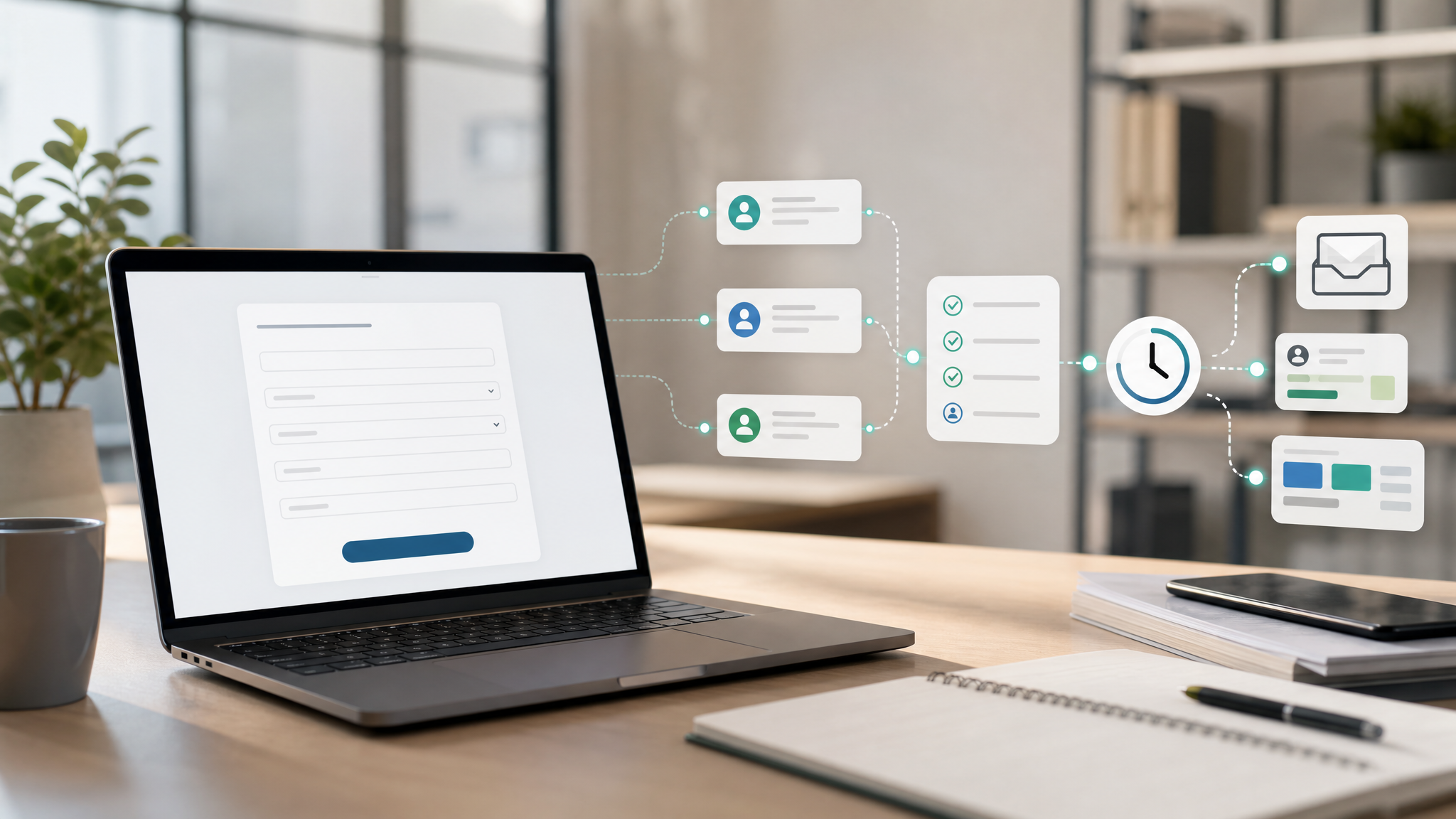
AI lead capture helps a small business turn website visits, form starts, missed calls, and message clicks into usable enquiries. The useful version is not a vague chatbot or a bigger ad budget. It is a better route from buyer intent to qualified next action.
For most UK SMEs, the first win is simple: make the page answer the buyer faster, ask for the right details, route the enquiry clearly, and measure whether more qualified leads reach the owner or sales team.
Quick Answer
AI lead capture for a small business should collect one safe buyer route, qualify the enquiry with a few useful fields, summarise the need, and trigger the right follow-up. Start with the highest-intent page or form path before adding more traffic. A good first slice improves conversion clarity, response speed, and enquiry quality without asking for private access or changing live customer workflows without approval.
Why Lead Capture Fails Before AI Helps
Most lead capture problems are not caused by a missing AI tool. They are caused by friction in the buyer path:
- The page does not say who the service is for.
- The CTA asks for contact before the buyer knows what happens next.
- The form asks too much, too little, or the wrong thing.
- Enquiries arrive without service type, location, urgency, or budget context.
- Nobody knows which lead should be answered first.
- Missed calls and form submissions are handled in separate places.
- Follow-up relies on the owner remembering the next step.
AI can help once that path is visible. If the underlying route is unclear, AI only makes the confusion faster.
The Best First Lead Capture Slice
Choose one page, one enquiry route, and one proof signal.
Good first candidates include:
- A service page that gets traffic but weak enquiries.
- A homepage CTA that sends buyers to a generic contact form.
- A quote-request form that misses key qualification details.
- A missed-call path where good leads cool before reply.
- A campaign page where visitors need a clearer next step.
Do not start by rebuilding the whole funnel. Start with the route closest to revenue and fix the smallest piece that blocks qualified enquiries.
What An AI Lead Capture System Should Ask
The form or capture route should ask only what the first response needs.
For many service businesses, that means:
- Name and email or phone.
- Website or public page if the request is about a digital surface.
- Service or problem type.
- Location or service area.
- Urgency.
- The buyer's main symptom.
- Any proof signal that would make the fix worthwhile.
- Approval boundary: review-only, source-ready, or publish-after-proof.
That is enough context to prioritise and reply. Asking for passwords, private data, analytics logins, inbox access, API keys, or customer records at this stage is a red flag.
How AI Qualification Should Work
A practical AI qualification route should support the team, not hide decisions from them.
The safe pattern is:
- Capture the buyer's details and public context.
- Classify the enquiry by route: visibility, capture, response, or admin.
- Summarise the likely bottleneck.
- Flag missing context before the owner replies.
- Suggest the next useful action.
- Keep sensitive or customer-facing changes behind human approval.
This turns a form submission into a usable brief. It also gives the business a cleaner record of what buyers are actually asking for.
Proof Signals To Measure
Pick one proof signal before building.
Useful signals include:
- More form starts from the same page.
- More completed enquiries with useful detail.
- Faster first response.
- Fewer unqualified calls or messages.
- Fewer back-and-forth emails asking for basics.
- More enquiries routed to the correct service.
- Better handoff from website to owner, CRM, inbox, or task list.
Avoid vague promises such as "more AI leads" without a visible before-and-after check. The first slice should prove one change, not claim the whole funnel is fixed.
What To Improve On The Page
Before adding automation, check the page itself.
A high-intent lead capture page should include:
- A direct answer to the buyer's problem near the top.
- A clear service, audience, location, and outcome.
- CTA copy that explains the next step.
- Proof or process detail near the CTA.
- A form that asks for the right minimum context.
- Privacy-safe wording that says what not to send.
- A response expectation so the buyer knows what happens after submission.
This matters for SEO, AEO, and AIO too. Search engines and AI assistants need the same clarity buyers need: what the business does, who it helps, what the next action is, and what proof supports it.
When To Use A Chatbot
A chatbot can help when buyers ask repeated questions and need routing before the form. It is not always the best first lead capture fix.
Use a chatbot only when:
- The buyer needs help choosing a service route.
- The questions are predictable.
- The bot can hand off to a human clearly.
- The business can review transcripts and improve the flow.
- The bot does not make sensitive promises or pricing decisions.
If the page has weak copy or a confusing CTA, fix that first. A chatbot layered on top of a poor page usually adds friction.
Lead Capture And Missed Calls
Many SMEs lose leads because phone, form, and email routes are disconnected. AI lead capture can help by turning missed calls and form submissions into the same qualification pattern.
The first version might:
- Capture the source.
- Ask for the service type.
- Identify urgency.
- Summarise the buyer need.
- Create a follow-up task.
- Draft a reply for review.
That is safer than trying to automate every conversation. The business keeps control while response speed improves.
FAQ
What is AI lead capture for small businesses?
AI lead capture is the use of AI-supported forms, routing, summaries, chat, or workflows to collect better enquiry context and trigger a faster, clearer follow-up. For small businesses, it should improve enquiry quality and response speed without asking for unnecessary private access.
What is the best first lead capture improvement?
The best first improvement is usually one high-intent page or form path where buyers already show interest but the route is unclear. Improve the answer, CTA, form fields, qualification summary, and follow-up handoff before buying more traffic.
Does AI lead capture replace a CRM?
No. AI lead capture can feed a CRM, inbox, spreadsheet, or task list, but it should not replace the system of record without a clear migration plan. Start by improving capture and handoff, then connect deeper systems only after the first proof signal is clear.
Is an AI chatbot necessary for lead capture?
Not always. A better CTA, form, response promise, and qualification route often produce a clearer first win. A chatbot is useful when buyers need guided routing or repeated question handling before they are ready to submit an enquiry.
Next Step
Choose the page or route closest to revenue: a service page, homepage CTA, quote form, missed-call path, or campaign page. Send that one surface through the free AI audit with the symptom and proof signal. Halo can then map the smallest useful lead capture slice before a broader automation or traffic project.